St Mark the Evangelist and Venice
Who St Mark was, how his body reached Venice, and where the story is told in the Basilica built for him.
- Relics from Alexandria
- Feast day 25 April
- Symbol: winged lion
Official Tiqets partnerBest booked in advance
Entry with a host at the door
- Ticket on your phone
- Sent to you instantly
- Free cancellation up to 48 hours before
- Tiqets support 24/7
In short
- St Mark is the Evangelist traditionally credited with the second Gospel, and the patron saint of Venice.
- His relics came from Alexandria in Egypt on 31 January 828 (official page on the saint) or in 829 (official chronology).
- On 25 June 1094 the relics were rediscovered in the Basilica; on 8 October 1094 they were laid in the crypt.
- His feast day is 25 April; his symbol is the winged lion.
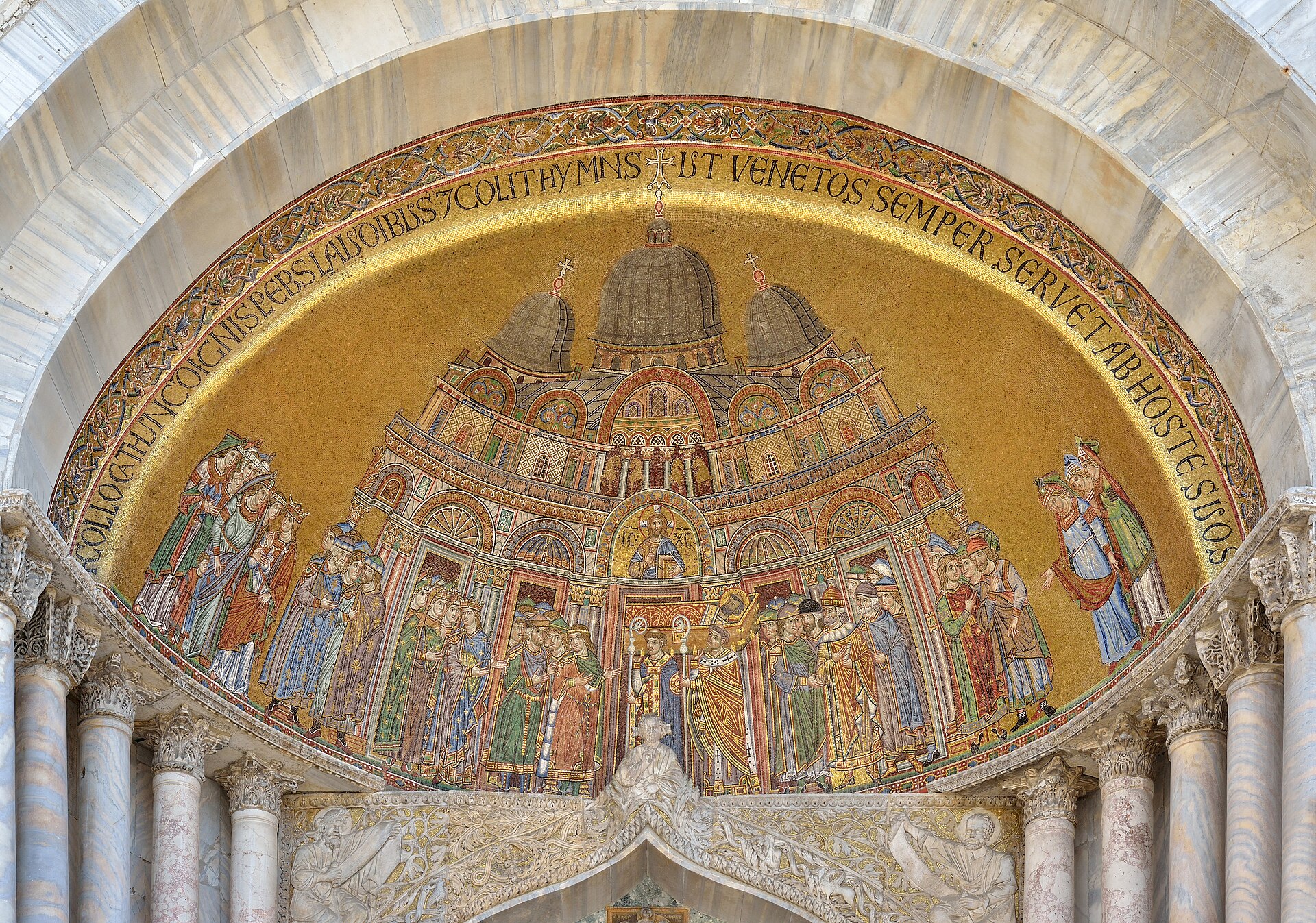
St Mark the Evangelist, traditionally the author of the second Gospel, is the patron saint of Venice, and St Mark's Basilica exists because of him: it was built to hold his body, which Venetians brought from Alexandria in Egypt in the 9th century. His symbol, the winged lion, became the emblem of the city, and his feast falls on 25 April. This page follows the saint's story as the Procuratoria di San Marco, which runs the Basilica, tells it, and shows where to find it on your visit.
Who was St Mark?
Christian tradition identifies Mark as the author of one of the four Gospels and links him closely to Alexandria in Egypt, where his body lay before it came to Venice. In Christian art each Evangelist has a symbol, and Mark's is the lion, shown with wings. The official pages of the Basilica concentrate on what happened after his death: the journey of his relics and the church built around them.
How did St Mark's body reach Venice?
The Procuratoria's page on the saint gives a precise date: on 31 January 828 the relics of St Mark were brought from Alexandria to Venice and received by Doge Giustiniano Particiaco. The Procuratoria's chronology dates the same event to 829. Both are official sources, so you will see both years quoted.
A church followed within a few years. The first church of San Marco was consecrated in 832, under Doge Giovanni Partecipazio. It burned in 976 during a revolt and was rebuilt; work on the present Basilica began in 1063. The full timeline is on our history page.
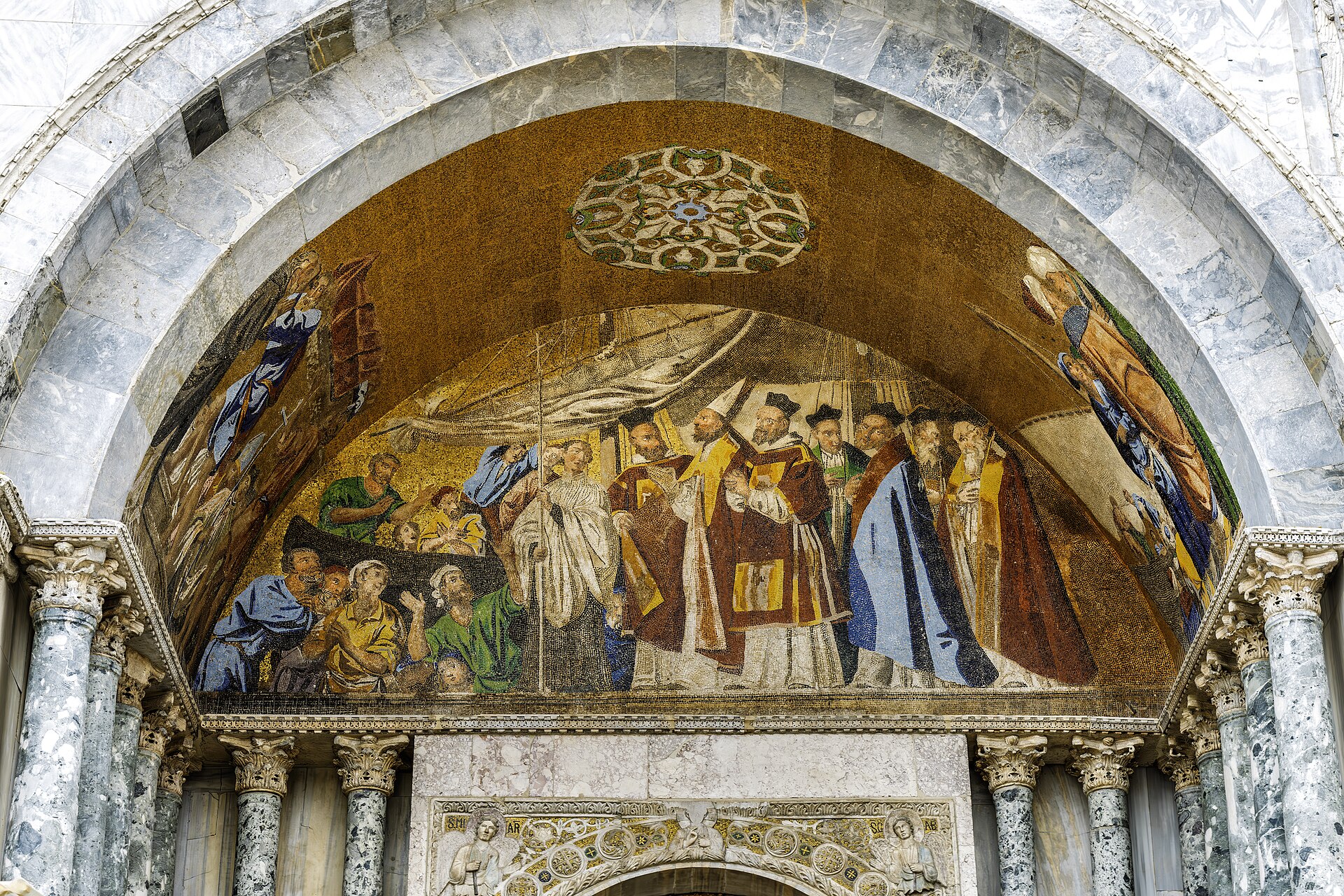
The lost and found relics of 1094
The story has a second chapter. When the new church was ready, according to the Procuratoria's account, on 25 June 1094 the saint revealed where his relics lay to Doge Vitale Falier, Bishop Domenico Contarini, the nobles and the people gathered in the Basilica. This rediscovery is known by its Latin name, the inventio.
On 8 October of the same year, Doge Falier placed the body in a sarcophagus in the crypt, which had been enlarged for the occasion. The church was consecrated the same year.
Where is the story told in the Basilica?
The saint's story runs through the building:
- The mosaics include scenes of the transfer of his body to Venice; the image at the top of this page is one of them.
- A lunette of the Basilica shows the body of St Mark being received in Venice.
- The painted panel by Paolo Veneziano and his sons (1343–1345), which once covered the Pala d'Oro and is now in the Museum, tells stories of St Mark and other saints.
- The rood screen of 1394 carries marble statues of the twelve Apostles, the Virgin and St Mark.
The basic visit along the fenced route lasts at most 20 minutes, so a guided tour helps if you want these scenes pointed out. What you see on the route is described on inside St Mark's Basilica.
Can you visit St Mark's tomb?
The crypt where the body was laid in 1094 is part of the Procuratoria's evening visits, which are private, guided visits for groups booked directly with the Procuratoria. The official pages don't list the crypt as part of the daytime ticket. Partner after-hours tours are on our after-hours page.
The lion of St Mark
Venice made the Evangelist's symbol its own. The Procuratoria describes the emblem of the Republic as a winged lion holding a book, open in peacetime on the words Pax tibi Marce Evangelista meus, "Peace to you, Mark, my Evangelist", and gripping a sword in wartime. More on the Lion of St Mark.
The feast of St Mark, 25 April
St Mark's feast day is 25 April. The Venetians chose that date to inaugurate the rebuilt Campanile in 1912, ten years after the old tower collapsed.
If you want to attend a service rather than visit as a tourist, entry for prayer, Mass and the liturgy is always free through the Porta dei Fiori on the north side of the Basilica, facing the Piazzetta dei Leoncini. The church opens for prayer every day from 7.30am to 7.30pm. On Sundays and holy days of obligation, the 10am Solemn Mass is sung by the Cappella Marciana, the Basilica's musical chapel since the early 14th century. Paying visitors are not admitted during services. All Mass times are on our Mass times page.
Visiting with the saint in mind
- Read the story before you go, then look for it overhead on the route.
- Add the Pala d'Oro (€20 with the Basilica, €30 in the full ticket) to see the altarpiece in person.
- The same Basilica ticket also gives entry, within six months, to the cathedral on Torcello, the sacristy of the Salute and about forty other Venetian churches.
Ticket options are on St Mark's Basilica tickets.
Tickets and tours
 Our pick
St. Mark's Basilica: Hosted Entry Ticket
★ 3.3 (819)
Official Tiqets partnerfrom €17
Check availability
St. Mark's Basilica: Skip The Line Ticket + Guided Tour
★ 3.8 (991)Free cancellation up to 48 hours before
Official Tiqets partnerfrom €28.80
Check availability
Prices are per adult, as a guide, refreshed daily from the partner; you see the final price on the partner's site before paying.
Frequently asked questions
Is St Mark buried in St Mark's Basilica?
When did St Mark's body come to Venice?
When is the feast of St Mark?
Can you visit St Mark's tomb?
Sources
Information checked on 10 November 2026.
- Procuratoria di San Marco, basilicasanmarco.it — San Marco evangelista
- Procuratoria di San Marco — Cronologia essenziale
- Procuratoria di San Marco — Il Campanile; Servizi liturgici; Visite serali
sanmarco1957.it is an independent guide: it is not the official website of the Basilica or of the Procuratoria di San Marco.