The Lion of St Mark
Venice's winged lion: what it stands for, what the book says, and where to find it around St Mark's Square.
- Symbol of St Mark
- Book open in peacetime
- Sword in wartime
Official Tiqets partnerBest booked in advance
Campanile entry + audio guide
- Ticket on your phone
- Sent to you instantly
- Tiqets support 24/7
In short
- The winged lion is the symbol of St Mark the Evangelist, patron of Venice, and became the emblem of the Venetian state.
- In peacetime the lion holds an open book with the words Pax tibi Marce Evangelista meus: Peace to you, Mark, my Evangelist.
- In wartime the lion was shown gripping a sword.
- Around the square you can see it on the Clock Tower and on the Piazzetta; the Campanile gives the view from above.
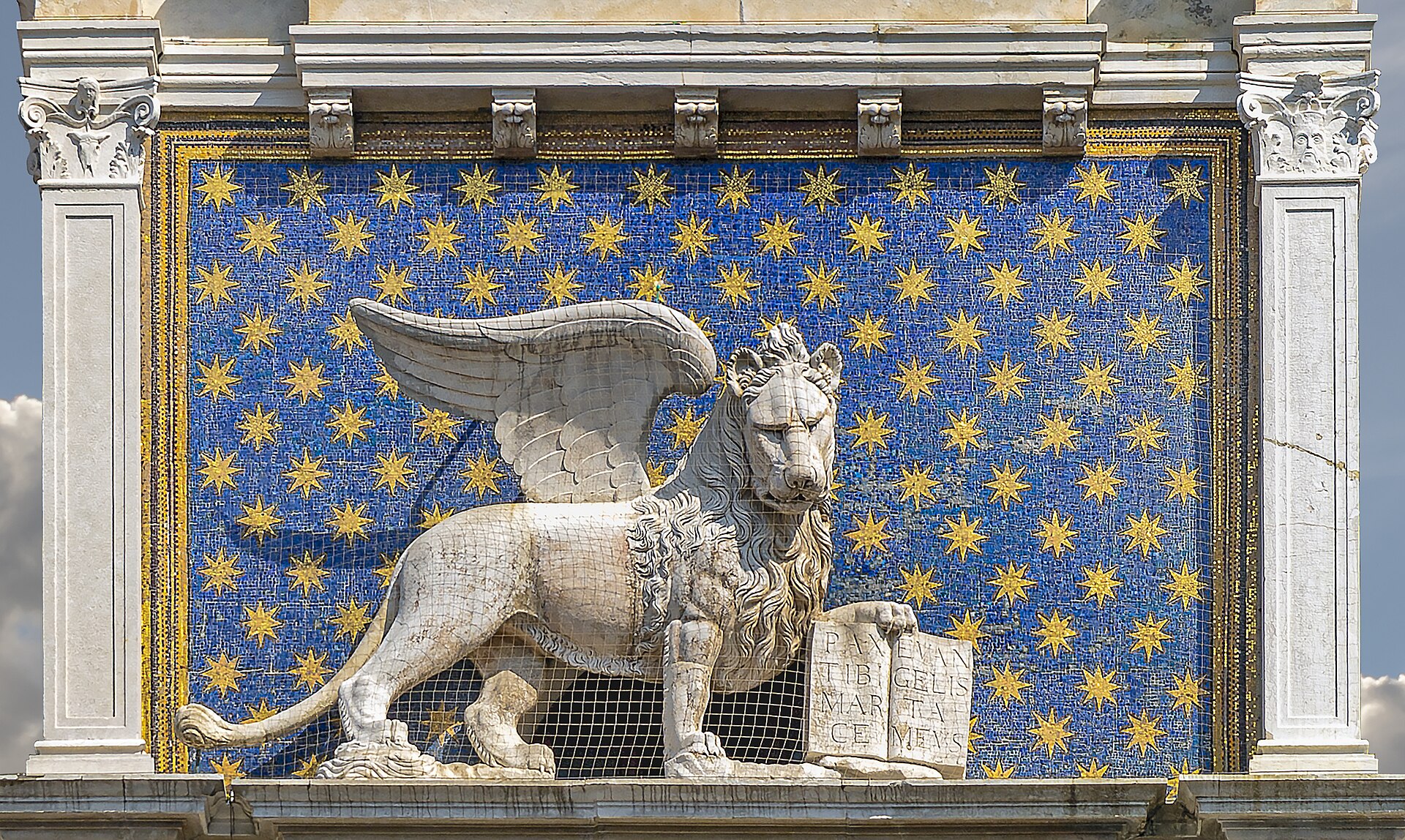
The lion of St Mark is a winged lion holding a book, and it stands for St Mark the Evangelist, the patron saint of Venice, whose body the city has kept since the 9th century. Through the saint it became the emblem of Venice itself and of its Republic. The Procuratoria di San Marco, which looks after the Basilica, describes how the lion was shown: with the book open in peacetime, on the words Pax tibi Marce Evangelista meus, and with a sword in its grip in wartime.
Why is the lion the symbol of Venice?
The answer starts with the relics. In 828, according to the Procuratoria's page on the saint (829 in its chronology), the body of St Mark was brought to Venice from Alexandria in Egypt and received by Doge Giustiniano Particiaco. The Basilica was built to house it, and Mark became the city's patron.
In Christian art each of the four Evangelists has a symbol, and Mark's is the winged lion. When Venice took Mark as its patron, it took his symbol too. The other three Evangelists have their own creatures in the same tradition: a man or angel for Matthew, an ox for Luke and an eagle for John.
Over the centuries the lion came to stand for the state as much as the saint: in the words of the Procuratoria, a symbol of the Republic in the form of a winged lion armed with a book.
What does the book say?
The open book carries a Latin phrase:
Pax tibi Marce Evangelista meus
It means "Peace to you, Mark, my Evangelist". It is a greeting addressed to the saint, and it is the phrase the Procuratoria gives for the lion's book in peacetime.
Open book or sword?
The Procuratoria's account is short: the book was open on that phrase in time of peace, and the lion gripped a sword in time of war. You will hear other explanations in Venice, for example about lions shown with a closed book. The Basilica's official pages don't cover them, so we don't repeat them as fact here.
Where can you see the lion around St Mark's Square?
You don't need a ticket to find it. Some places to look on and near the square:
- The Clock Tower. The lion of St Mark appears high on the front of the tower, facing the square. The tower itself, finished in 1499, is described on our Clock Tower page.
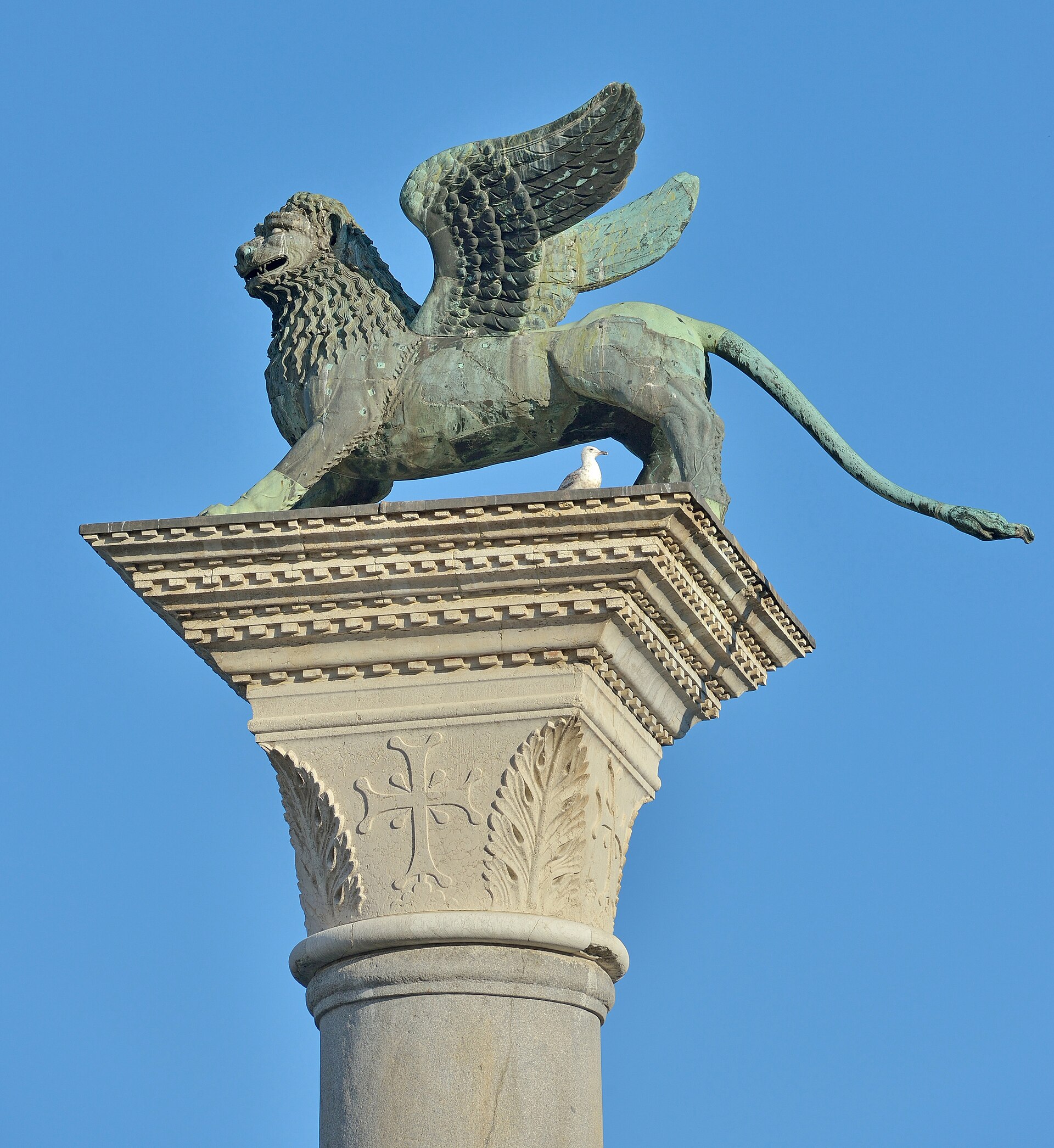
- The Piazzetta. A lion of St Mark stands on the Piazzetta, the open space between the Doge's Palace and the lagoon.
- Flags and buildings. Once you start looking, you will find the lion on flags and public buildings all over Venice.
Inside the Basilica, the story of the saint is told in mosaic; the lion's meaning makes more sense once you know it, so see St Mark the Evangelist before you go.
The lion and the feast of St Mark
St Mark's feast day is 25 April. The date has a place in the square's history too: the Campanile, rebuilt after its collapse in 1902, was inaugurated on 25 April 1912, the feast of St Mark.
See the square from above
The best view of the square's buildings, lions included, is from the top of the Campanile. The bell tower is 98.6 metres high and is topped by a figure of the Archangel Gabriel. Since 1932 a lift inside the shaft has carried visitors to the belfry in about 30 seconds; the way up and down is by lift only. The official full price is €15 (€7.50 reduced), and it is a separate ticket from the Basilica. More on the Campanile.
For the wider picture of what stands around the square and how it fits together, see our St Mark's Square guide and the history of the Basilica.
Tickets and tours
 Our pick

Prices are per adult, as a guide, refreshed daily from the partner; you see the final price on the partner's site before paying.
Frequently asked questions
What does the lion of St Mark symbolise?
What is written in the lion's book?
Why does the lion of Venice have wings?
Where can I see the lion of St Mark in Venice?
Sources
Information checked on 10 November 2026.
- Procuratoria di San Marco, basilicasanmarco.it — San Marco evangelista
- Procuratoria di San Marco — Il Campanile
- Fondazione Musei Civici di Venezia, torreorologio.visitmuve.it — La sede e la storia
sanmarco1957.it is an independent guide: it is not the official website of the Basilica or of the Procuratoria di San Marco.