The Treasury of St Mark's
Gold, silver and Byzantine reliquaries, the relics of the Evangelist, and what the published tickets cover.
- 283 pieces
- Survived the 1231 fire
- Relics of St Mark
Official Tiqets partnerBest booked in advance
- Ticket on your phone
- Sent to you instantly
- Tiqets support 24/7
In short
- The Treasury of St Mark's brings together 283 pieces in gold, silver, glass and other precious materials.
- After the Fourth Crusade took Constantinople in 1204, reliquaries, the Nicopeia icon and the Pala d'Oro enamels were brought to the Basilica.
- A fire on 13 January 1231 destroyed the room that housed it; only four reliquaries survived.
- The Procuratoria's price list has no separate Treasury ticket, and none of the tickets shown here lists it; ask at the Basilica before you plan around it.
- The body of St Mark was laid in a sarcophagus in the crypt in 1094; the crypt is part of the official evening visit, not of the daytime tickets.
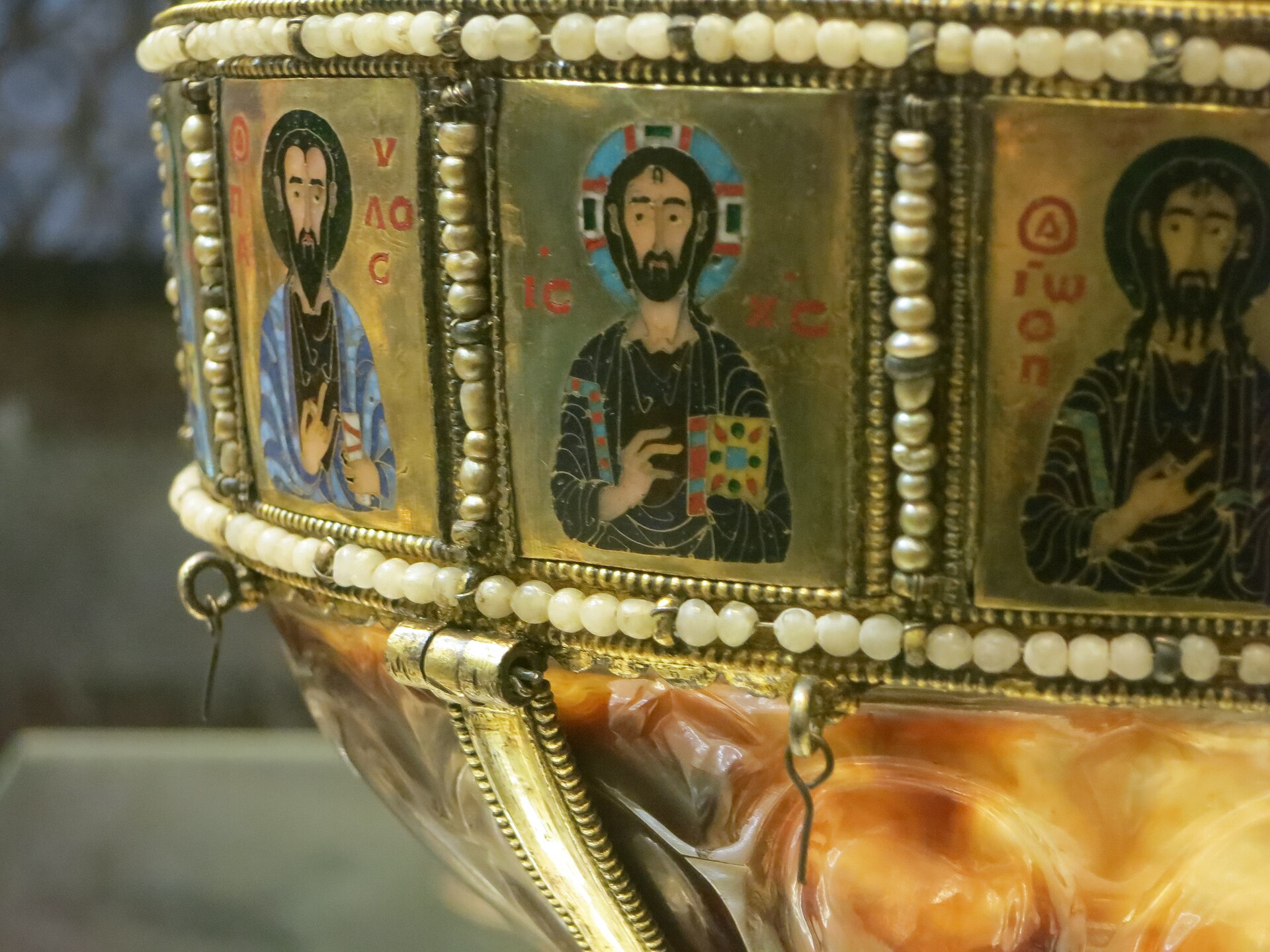
The Treasury of St Mark's holds 283 pieces in gold, silver, glass and other precious materials, of varied origin. Some of its oldest pieces came from Constantinople after the Fourth Crusade took the city in 1204. The Procuratoria di San Marco's published prices have no separate Treasury ticket, and none of the tickets on this page lists it among its inclusions. If seeing it matters to you, ask at the Basilica or contact the Procuratoria before you plan your visit around it.
What does the Treasury contain?
According to the Basilica's own description, the Treasury brings together 283 objects of varied origin, in gold, silver, glass and other precious materials.
An important group of pieces arrived after 1204. After the conquest of Constantinople in the Fourth Crusade, Doge Enrico Dandolo's Venice brought back marbles and works of art for the Basilica. The official chronology names the four horses, the icon of the Madonna Nicopeia, the enamels of the Pala d'Oro and reliquaries among them.
What happened to the Treasury over time?
Two events shaped the collection:
- The fire of 1231. On 13 January 1231 a fire completely destroyed the room that housed the Treasury. Only four reliquaries came through unharmed, all of them Byzantine pieces brought from Constantinople in 1204.
- The fall of the Republic in 1797. In the years after 1797, 537 kilos of gold and silver were taken from the Treasury of St Mark's and the Scuola dei Mascoli.
Can you visit the Treasury?
The Procuratoria's published prices cover four paying spaces: the Basilica, the Pala d'Oro, the Museum with the Horses' Loggia, and the Campanile. There is no Treasury ticket on that list, and the partner tickets shown on this page don't include the Treasury either. The official pages consulted for this guide don't say whether, when or how it can be visited, so no opening times or prices are given here.
What you can see on a standard visit:
- The Pala d'Oro, whose enamels came partly from the same 1204 haul. It costs €20 with the Basilica. See the Pala d'Oro.
- The Museum, with the original bronze horses brought from Constantinople. It costs €20 with the Basilica. See the Museum and terrace.
- The Nicopeia icon, which gives its name to the altar where weekday morning Masses are celebrated. See Mass times.
For questions about the Treasury, the Procuratoria's general address is info@procuratoriasanmarco.it, and for tickets help@procuratoriasanmarco.it.
The relics of St Mark
The Basilica exists because of a relic. According to the Basilica's page on the Evangelist, St Mark's remains were brought from Alexandria in Egypt to Venice on 31 January 828 and received by Doge Giustiniano Particiaco. The Basilica's own chronology gives the year as 829, so the two official pages don't agree.
The first church of St Mark was consecrated in 832. After a fire in 976 and rebuilding, the present church was begun in 1063 under Doge Domenico Contarini. In 1094 the relics were rediscovered: on 25 June the saint is said to have revealed where they lay to the Doge, the bishop and the people gathered in the Basilica. On 8 October 1094 Doge Vitale Falier placed the body in a sarcophagus in the crypt, which was enlarged for the occasion.
Can you see the crypt?
The crypt is part of the Procuratoria's private evening visit, which also includes the lit Basilica and the Pala d'Oro. That visit is sold per group, from €1,500 for up to 30 people, with a guide paid separately. The crypt isn't listed among the spaces of a daytime ticket. For individuals, partner after-hours tours are the way to see the church after closing, but check whether a given tour includes the crypt. See after-hours visits.
The story of the saint himself, and why Venice adopted him as its patron, is on the St Mark the Evangelist page. The broader history of the building is on the history page.
Visiting the Basilica with the treasures in mind
- Choose the full ticket (€30) if you want the Pala d'Oro and the Museum in one slot.
- Allow time. The rules give up to 20 minutes on the Basilica route and up to 10 at the Pala d'Oro; the Museum has no published limit.
- Mind the dress code: shoulders and knees covered. See dress code and rules.
Tickets and tours
 Our pick
St. Mark's Basilica: Hosted Entry Ticket + Terrace Access
★ 3.3 (283)
Official Tiqets partnerfrom €50
Check availability
St. Mark's Basilica: Hosted Entry Ticket
★ 3.3 (819)
Official Tiqets partnerfrom €17
Check availability
Prices are per adult, as a guide, refreshed daily from the partner; you see the final price on the partner's site before paying.
Frequently asked questions
What is in the Treasury of St Mark's?
Is the Treasury included in the Basilica ticket?
Where are the relics of St Mark?
When did the relics of St Mark arrive in Venice?
Sources
Information checked on 10 November 2026.
- basilicasanmarco.it — Il Tesoro
- basilicasanmarco.it — San Marco Evangelista
- basilicasanmarco.it — chronology
- Procuratoria di San Marco, online shop — prices (tickets.basilicasanmarco.it)
- Procuratoria di San Marco — evening visits (PDF)
sanmarco1957.it is an independent guide: it is not the official website of the Basilica or of the Procuratoria di San Marco.