History of St Mark's Basilica
From the arrival of St Mark's relics in the 9th century to the flood defences of 2025, date by date.
- Present church begun 1063
- Consecrated 1094
- Cathedral since 1807
Official Tiqets partnerBest booked in advance
Skip the line + live guide
- Ticket on your phone
- Sent to you instantly
- Free cancellation up to 48 hours before
- Tiqets support 24/7
In short
- The relics of St Mark reached Venice from Alexandria in 828 according to one official page, 829 according to the official chronology.
- The present church was begun in 1063 under Doge Domenico Contarini and consecrated in 1094.
- For about a thousand years it was the Doge's chapel, not the city's cathedral.
- After 1204 the four bronze horses, the Nicopeia icon and enamels of the Pala d'Oro came from Constantinople.
- It became the cathedral and seat of the Patriarch in 1807.
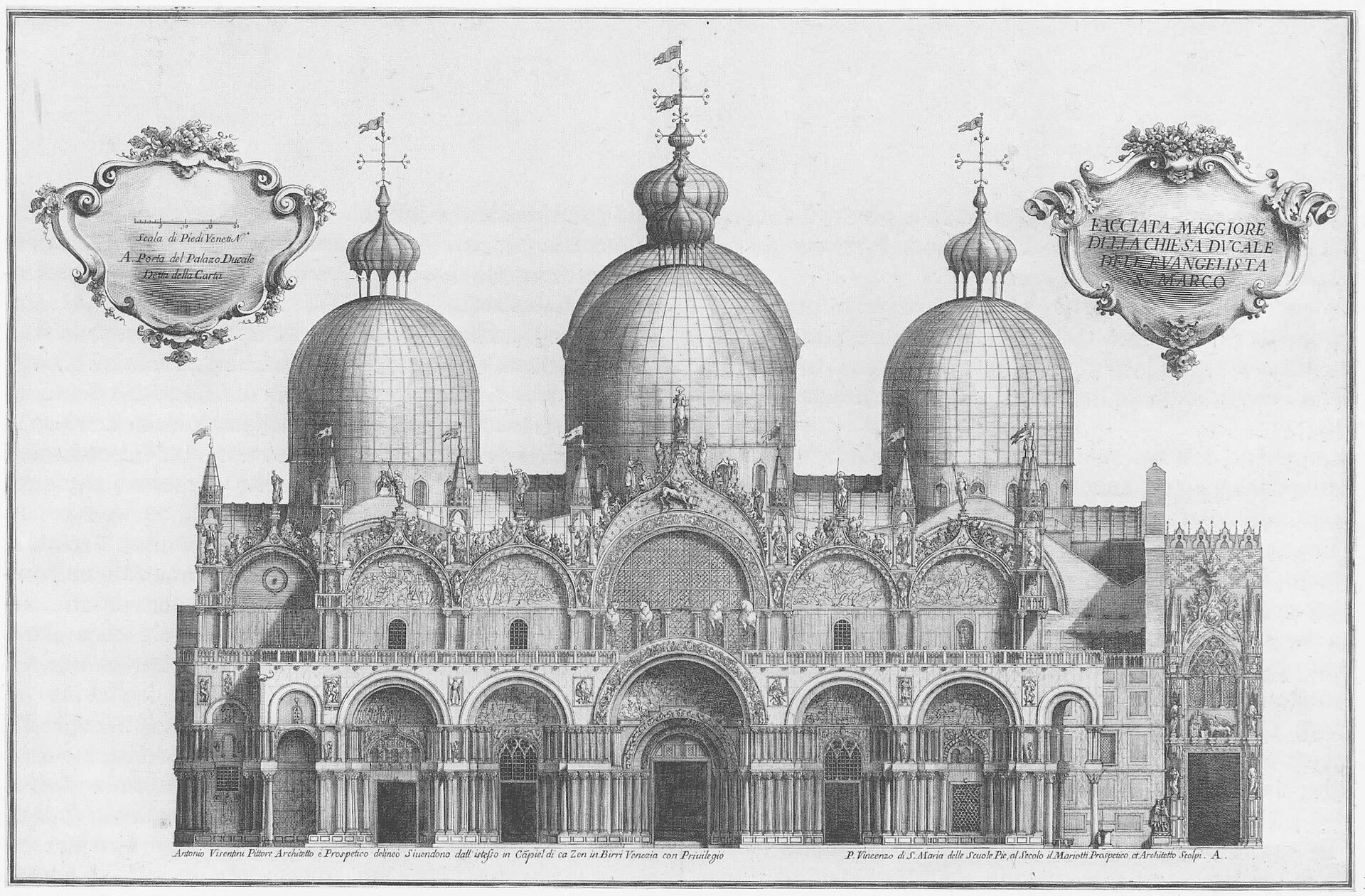
St Mark's Basilica was built to hold the body of St Mark the Evangelist, brought to Venice from Alexandria in Egypt in the 820s. The church you see today replaced earlier ones on the same site: it was begun in 1063 under Doge Domenico Contarini and consecrated in 1094. For most of its life it was not the city's cathedral but the private chapel of the Doge, the church of the Venetian state, and that is the key to why it looks the way it does.
The relics and the first churches (828–978)
The Basilica's history starts with a body. On 31 January 828, according to the Procuratoria's page on St Mark, the relics of the Evangelist arrived from Alexandria and were received by Doge Giustiniano Particiaco. The Procuratoria's own chronology gives the year as 829. Both pages are official, so we give both dates.
- 832 – the first church of San Marco is consecrated under Doge Giovanni Partecipazio.
- 976–978 – the church burns during the revolt against Doge Candiano IV and is rebuilt under Doge Pietro Orseolo I.
The full story of the saint and the journey from Alexandria is on our page about St Mark the Evangelist.
When was the present church built? (1063–1094)
- 1063 – rebuilding begins on the church that stands today, under Doge Domenico Contarini.
- 1071–1084 – the mosaic decoration begins, under Doge Domenico Selvo.
- 1094 – the church is consecrated under Doge Vitale Falier.
The year 1094 has a story of its own. The official account says that on 25 June, before the Doge, the bishop, the nobles and the people gathered in the Basilica, the saint revealed where his relics lay: the event known as the inventio, the rediscovery. On 8 October 1094 Doge Falier placed the body in a sarcophagus in the crypt, which had been enlarged for the occasion.
The Doge's church
For about a thousand years the Basilica served as the ducal chapel, answerable directly to the Doge, who appointed its senior cleric, the Primicerio. Politics happened here as well as worship. In 1177 the Peace of Venice, the meeting between Pope Alexander III and Emperor Frederick Barbarossa, took place in the Basilica; their names are carved in the marble floor of the atrium in memory of it.
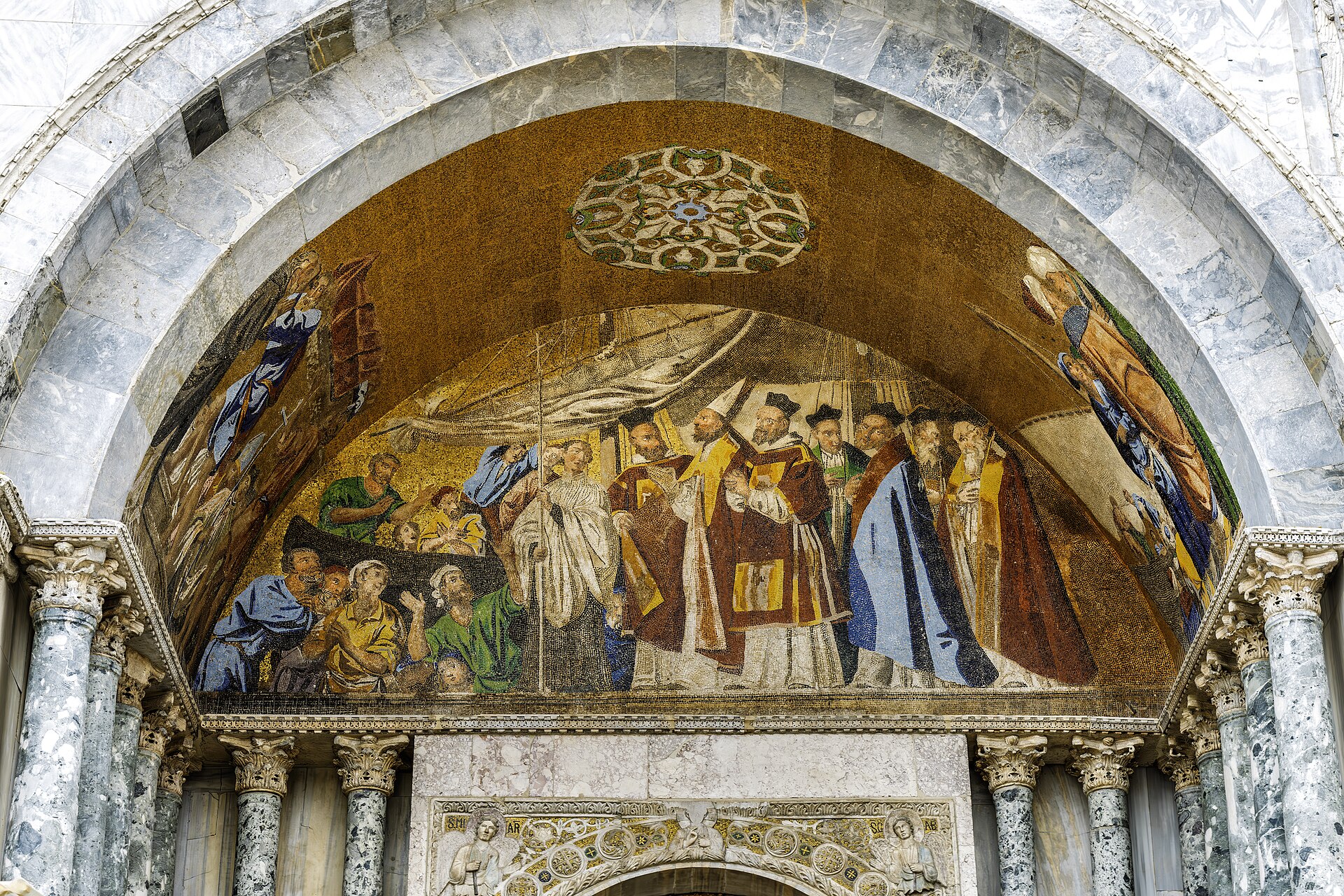
The spoils of 1204
The Fourth Crusade and the conquest of Constantinople in 1204 changed the Basilica. Under Doge Enrico Dandolo, marbles and works of art were shipped to Venice and brought into the church, among them:
- the four bronze horses, probably from the Hippodrome of Constantinople;
- the Madonna Nicopeia, an icon that still has its own altar;
- enamels later set into the Pala d'Oro;
- reliquaries, four of which survived the Treasury fire of 1231.
After the fall of the Latin Empire in 1261, the horses were placed on the loggia of the Basilica, where they stayed until 1977.
Building up the Basilica (13th–16th centuries)
- 13th century – the tall outer domes are added: wooden structures covered in lead, built over the original brick domes.
- 13 January 1231 – fire destroys the Treasury room; only four Byzantine reliquaries survive.
- 1343–1345 – under Doge Andrea Dandolo the Pala d'Oro is entirely remade and takes its present form, after earlier phases under Ordelaffo Falier (1102–1118) and Pietro Ziani (renewed in 1209).
- 1343–1354 – the Baptistery and the Chapel of Sant'Isidoro are built, also under Andrea Dandolo.
- 1394 – the date carved on the marble rood screen by Jacobello and Pierpaolo dalle Masegne, with its 14 statues.
- 1504–1521 – the Zen Chapel is built in the atrium, closing off the doorway that once faced the lagoon.
- 1527–1570 – Jacopo Sansovino is the Basilica's chief architect (proto); he designed the baptismal font and is buried in the Baptistery.
The Basilica also has its own musical tradition. Its musical chapel, the Cappella Marciana, was founded at the beginning of the 14th century and became the centre of musical life in Venice; it still sings the 10am Solemn Mass on Sundays.
From state church to cathedral (1797–1807)
After 1797, 537 kilograms of gold and silver were taken from the Treasury and the Scuola dei Mascoli. In 1807, by the will of Napoleon, the cathedral of Venice was moved from San Pietro di Castello to San Marco, which became the seat of the Patriarch. So, for all its age, the Basilica has been a cathedral only since 1807.
The 20th century to today
- 14 July 1902 – the Campanile on the square collapses, without victims. It is rebuilt "as it was, where it was" and inaugurated on 25 April 1912, the feast of St Mark.
- 16 May 1927 – the Museum of San Marco opens to the public.
- 1958 – at the request of Patriarch Angelo Roncalli, a mechanism is fitted so that the Pala d'Oro can be turned.
- 1977–1982 – the horses are taken down from the loggia, restored and moved into the Museum; bronze copies replace them outside.
- 8 October 2003 – the Museum's present layout is inaugurated.
- 2019 – in the acqua granda, the great flood, seawater enters the crypt through its windows.
- April 2025 – works on the rear of the Basilica complete its protection against high water, together with the glass barrier on the square.
More on the flood defences on acqua alta and the Basilica.
A short history of St Mark's Square
Several landmarks around the square have dates you can pin down:
- 1497 – Ambrogio delle Ancore casts the two giant bronze automata of the Clock Tower, known as the Mori.
- 1 February 1499 – the Clock Tower is finished and its mechanism installed; its wings follow in the early 1500s.
- 1537–1549 – Jacopo Sansovino's Loggetta is built at the foot of the Campanile.
- 21–24 August 1609 – Galileo Galilei uses the Campanile to show his telescope to the Doge.
- 1902–1912 – the Campanile and the Loggetta are destroyed and rebuilt.
What to see on the square today is on our St Mark's Square guide; the tower's story is on the Clock Tower and the Campanile pages.
Seeing the history for yourself
A guided tour is the easiest way to connect these dates to what is on the walls; the basic visit route lasts at most 20 minutes. To see the horses, the Pala d'Oro and the view from the loggia, you need the full ticket or the matching combination; prices are on the tickets page.
Tickets and tours
 Our pick
St. Mark's Basilica: Skip The Line Ticket + Guided Tour
★ 3.8 (991)Free cancellation up to 48 hours before
Official Tiqets partnerfrom €28.80
Check availability
St. Mark's Basilica: Hosted Entry Ticket + Terrace Access
★ 3.3 (283)
Official Tiqets partnerfrom €50
Check availability
Prices are per adult, as a guide, refreshed daily from the partner; you see the final price on the partner's site before paying.
Frequently asked questions
When was St Mark's Basilica built?
Why was St Mark's Basilica built?
Is St Mark's Basilica a cathedral?
Where do the horses of St Mark come from?
Sources
Information checked on 10 November 2026.
- Procuratoria di San Marco, basilicasanmarco.it — Cronologia essenziale
- Procuratoria di San Marco — San Marco evangelista; La basilica, funzione politica e religiosa
- Procuratoria di San Marco — Museo di San Marco; La Pala d'Oro; Il Tesoro; Il Campanile; La Loggetta
- Procuratoria di San Marco — press release, April 2025
sanmarco1957.it is an independent guide: it is not the official website of the Basilica or of the Procuratoria di San Marco.