The Pala d'Oro
The golden altarpiece behind the high altar: its history, what to look for and how to get in.
- €20 with the Basilica
- Up to 10 minutes
- 1,927 gems
Official Tiqets partnerBest booked in advance
Basilica, terrace and Pala d'Oro
- Ticket on your phone
- Sent to you instantly
- Tiqets support 24/7
In short
- The Pala d'Oro is the golden altarpiece of St Mark's Basilica: 3.34 m wide and 2.12 m high, with about 250 cloisonné enamels and 1,927 gems.
- It has its own entrance fee: €20 for the Basilica with the Pala d'Oro, or €30 for the full ticket with the Museum and terrace.
- With a Basilica-only ticket you can add the Pala d'Oro on the spot.
- The rules allow up to 10 minutes in front of it, on top of the Basilica route.
- It is open at the same times as the Basilica: from 9.30am Monday to Saturday, from 2pm on Sundays.
Tickets with the Pala d'Oro
 Our pick
St. Mark's Basilica: Hosted Entry + Terrace & Pala d’Oro Access
★ 3.5 (154)
Official Tiqets partnerfrom €85
Check availability
St. Mark's Basilica: Guided Tour + Terrace & Pala d’Oro Access
Official Tiqets partnerfrom €89
Check availability
Venice: Saint Mark’s Basilica Small Group & Private Tours
★ 4.5 (19)
GetYourGuidefrom €150
Check availability
Prices are per adult, as a guide, refreshed daily from the partner; you see the final price on the partner's site before paying.
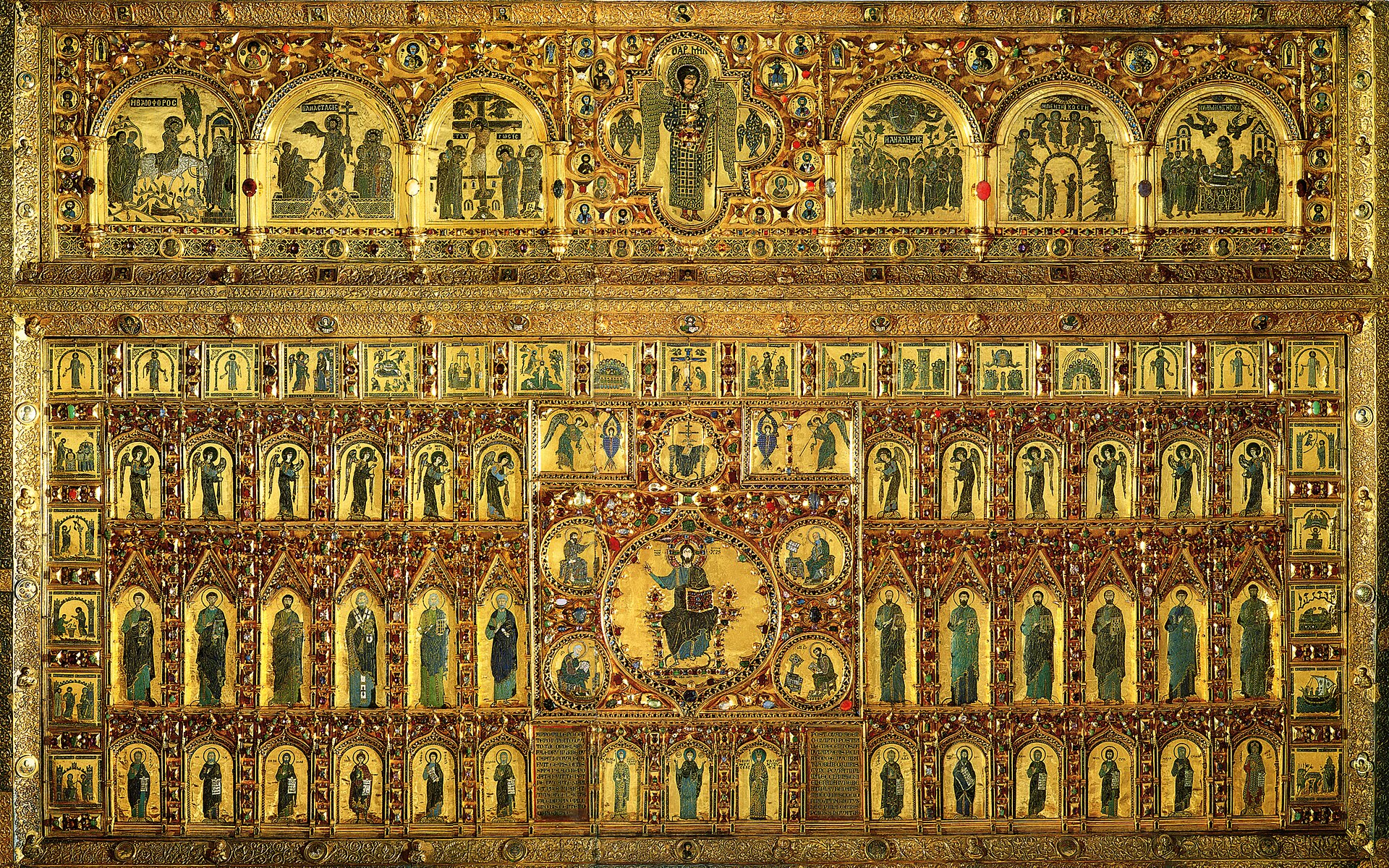
The Pala d'Oro is the golden altarpiece behind the high altar of St Mark's Basilica, and you need a ticket that includes it. Officially, the Basilica with the Pala d'Oro costs €20 for an adult, and the €30 full ticket adds the Museum and the Horses' Loggia. It measures 3.34 metres wide and 2.12 metres high, holds about 250 cloisonné enamels on gilded silver sheet, and is set with 1,927 precious stones and gems.
How do you see the Pala d'Oro?
The Pala d'Oro is a separate paid space inside the Basilica, with its own time limit: the rules allow up to 10 minutes there.
- Official tickets: €20 for the Basilica with the Pala d'Oro, €10 reduced; €30 for the full ticket with the Museum and the Horses' Loggia, €15 reduced. Both are timed and named.
- Adding it on the day: if you hold a Basilica-only ticket, you can extend it once there and pay for the Pala d'Oro.
- Partner tickets: on Tiqets, one option combines a hosted entry with the terrace, the Pala d'Oro and an audio guide in English, French, Italian or Spanish; another adds a live guide. Some small-group and private tours on GetYourGuide include it too.
Reduced tickets are half price for ages 11 to 18, students up to 26 and visitors over 65; children under 11 go free. The tickets page compares every option.
When is it open?
The Pala d'Oro keeps the same hours as the Basilica: Monday to Saturday from 9.30am, Sundays and holy days of obligation from 2pm, with last entry at 4.45pm and closing at 5.15pm. Times can change for major celebrations. See opening hours.
How the Pala d'Oro was made
It wasn't made in one go. The official history describes three stages:
- 1102–1118: the lower part goes back to the time of Doge Ordelaffo Falier.
- 1209: an inscription records that the Pala was renewed under Doge Pietro Ziani, a few years after the Fourth Crusade. The enamels that came from Constantinople in 1204 were among the treasures brought to the Basilica after the city was taken.
- 1343–1345: under Doge Andrea Dandolo the whole altarpiece was renewed and took on the appearance it has today.
The altarpiece is divided into two parts, an upper and a lower one.
Why does it face the back of the church?
For most of its history the Pala faced the nave. In 1958, at the request of the Patriarch, Angelo Roncalli, a mechanism was installed that turns it. It is normally turned away from the nave so that visitors can see it.
For weekdays, painted covers once closed over the gold. The oldest of them, by Paolo Veneziano and his sons in 1343–1345, shows stories of St Mark and other saints, and is now in the Museum.
What to look for
- The enamels. About 250 cloisonné enamels on gilded silver sheet, some of them brought from Constantinople after 1204.
- The gems. 1,927 precious stones and gems.
- The two parts. The upper and the lower part, the lower one going back to Ordelaffo Falier's time.
With ten minutes, it's worth looking closely at a few panels rather than trying to take in the whole surface. A guide or an audio guide helps you know where to start; the guided tours page lists the options that include the Pala d'Oro.
Combining it with the rest of the visit
The Pala d'Oro sits at the heart of the Basilica's treasures. The Treasury holds reliquaries and precious objects from the same Byzantine world, and the Museum keeps the original bronze horses. The full ticket covers the Pala d'Oro and the Museum in one slot.
Frequently asked questions
Is the Pala d'Oro included in the Basilica ticket?
How long can you spend at the Pala d'Oro?
How many gems are on the Pala d'Oro?
Who made the Pala d'Oro?
Sources
Information checked on 10 November 2026.
- basilicasanmarco.it — La Pala d'Oro
- basilicasanmarco.it — chronology
- Procuratoria di San Marco, online shop — prices and opening hours (tickets.basilicasanmarco.it)
- Procuratoria di San Marco — access regulations (PDF)
sanmarco1957.it is an independent guide: it is not the official website of the Basilica or of the Procuratoria di San Marco.